How to match 18 × 18 throw pillows with a patterned rug
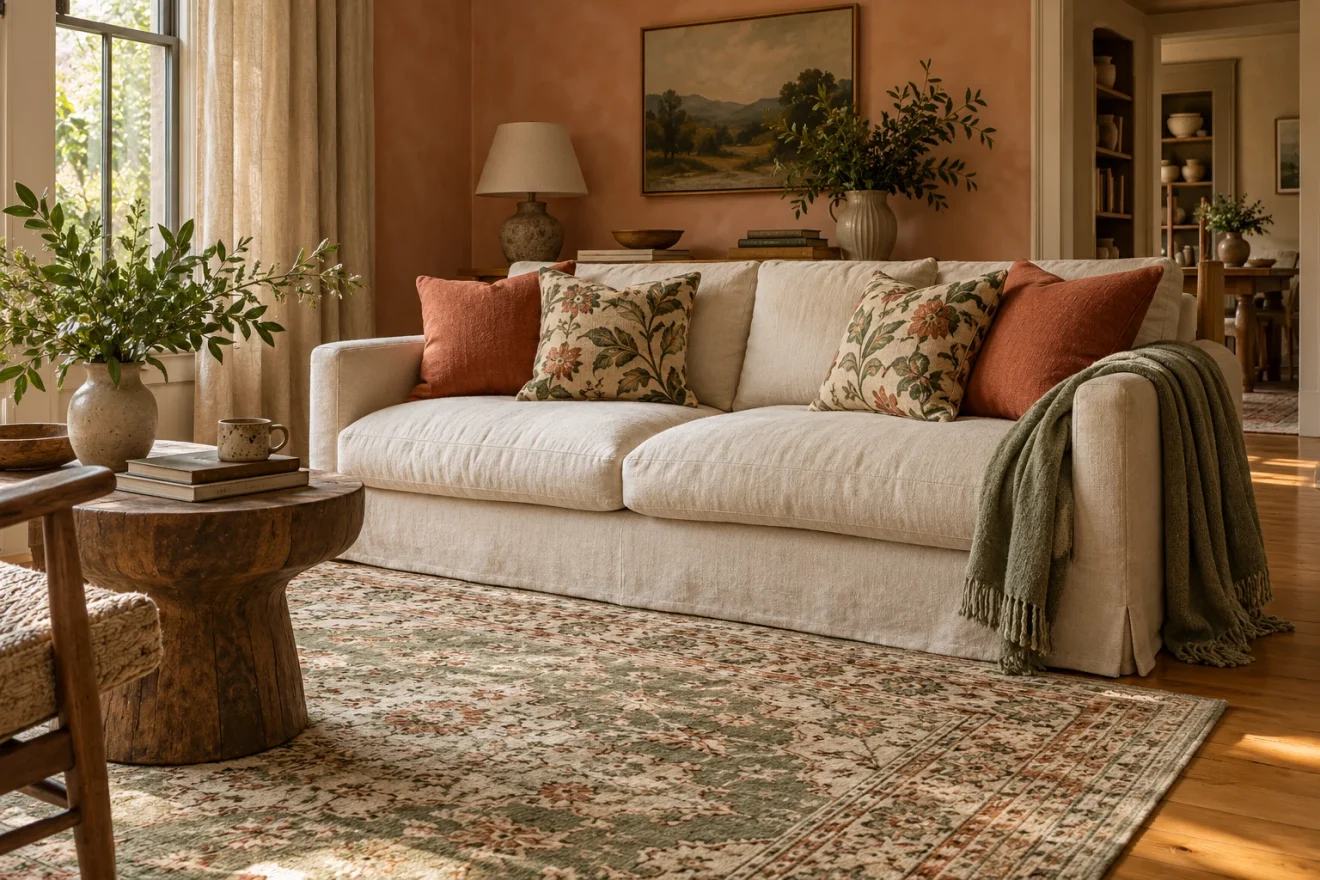
Skip four competing prints: bookend two solid 18"×18" faux-linen covers outside two medium-scale hero prints, all stuffed with 20"×20" inserts.
- Sofa corner formula
- 2 Solid Texture + 2 Hero Print (18"×18" covers)
- Insert upsize rule
- 20" × 20" inserts inside 18" × 18" covers (+2")
- Motif scale contrast
- 3"–5" pillow repeat vs. 12"+ large rug pattern
Inside this playbook & styling basis
Curated by Elena Rostova, Senior Textile & Color Stylist. Published pillow cover sizes, fabric content, and price bands checked against linked retailer pages (October 2026); pairing notes reflect our editorial guidance.
The 2+2 pillow & patterned rug diagram
Schematic diagram below: 84" Sofa + 4× 18"×18" Covers + 8×10 Rug · Button opens our 60-30-10 bath wizard in this Terracotta palette
- 60% Dominant hero pattern or room anchor
- 30% Grounding solid texture (faux-linen / mat / placemats)
- 10% Framed motif echo & hardware accents
Schematic diagram (not drawn to scale; key dimensions labeled). Tap Inspect dimensions to enlarge.
How this formula works (and when to adapt it)
- Proportion rule
- 2+2 Corner Symmetry = [Outer Left Solid (30% rug border shade) + Inner Left Print (10% accent)] + [Inner Right Print + Outer Right Solid]. Insert Size = Cover Size + 2".
- Room & fabric assumptions
- Designed for standard 72" to 90" 3-seat sofas paired with a patterned 5×8 or 8×10 ft area rug, using four 18"×18" square covers stuffed with 20"×20" feather/down-alternative inserts.
- When to adjust
- On shallow-seat mid-century sofas (seat depth under 20"), four 20"-stuffed pillows can eat into seating depth—either use 18"×18" inserts on the two inner pillows or swap the inner pair for a single 12"×20" central lumbar pillow.
| Pillow Position | Cover & Insert Spec | Pattern / Texture Role | How It Connects to the Area Rug |
|---|---|---|---|
| Outer Left Corner (#1) | 18"×18" Cover + 20"×20" Insert | Solid Heavyweight Faux-Linen / Bouclé | Pulls the 30% secondary neutral or muted sage/oatmeal border tone from the rug |
| Inner Left Overlap (#2) | 18"×18" Cover + 20"×20" Insert | Hero Motif Print (3"–5" Repeat) | Echoes the wall art above the sofa while sharing 1-2 accent shades with the rug |
| Inner Right Overlap (#3) | 18"×18" Cover + 20"×20" Insert | Companion Motif Print (3"–5" Repeat) | Contrasts with the rug’s large 12"+ medallion scale so patterns never compete |
| Outer Right Corner (#4) | 18"×18" Cover + 20"×20" Insert | Solid Heavyweight Faux-Linen / Bouclé | Bookends the sofa armrests so busy prints stay framed inside a calm border |
There's more to the recipe. Swipe the table to see every detail.
1. Step One: Pull Two Colors From Your Area Rug (Not Five)
A patterned Persian, geometric, or botanical area rug often contains four to six colors. Trying to represent all six colors on your sofa creates a scattered patchwork look. Instead, stand at the doorway and identify just two shades in your rug: (1) the quietest secondary background or border tone (usually warm oatmeal, sage, slate, or terracotta), and (2) the crispest 10% accent shade.
Assign that quiet secondary tone to your two outer solid 18"×18" pillow covers (#1 and #4), and use the accent shade inside your two inner patterned covers (#2 and #3). Because the solid covers sit directly against the sofa armrests, they create a visual buffer between the sofa upholstery and the patterned prints.
2. Two Reliable Pairing Approaches: Symmetrical 2+2 vs. Relaxed Asymmetric
With a set of four 18"×18" covers (2 solids + 2 prints), you can style a 72"–90" sofa in two ways: (Approach A: Architectural 2+2 Symmetry) Place one solid cover on each outer corner and overlap one patterned cover 4 inches in front of each solid, leaving 28" to 34" of open center cushion so three people can sit down without moving pillows to the floor.
(Approach B: Relaxed Studio Grouping) Place one solid + one patterned pillow on the left corner, and group the second solid + two overlapping patterned/lumbar pillows on the chaise or right corner. Both approaches work because the 50/50 ratio of solid texture to printed motif stays intact.
3. The Scale Contrast Rule: 12"+ Rug Motif vs. 3"–5" Pillow Repeat
Two patterns only fight each other when their motif scale is identical. If your 8×10 area rug has a large-scale medallion, arch, or stripe repeat measuring 10 to 18 inches across, choose pillow prints with a tighter 3- to 5-inch botanical or organic block-print repeat.
Conversely, if your area rug is a fine micro-grid, pinstripe, or tweed (under 2-inch repeat), choose bold, open-background botanical stems or large geometric shapes for your two inner hero pillows.
4. Material Differences & Why 20"×20" Inserts Make 18"×18" Covers Look Custom
Even expensive pillow covers look flat if stuffed with same-size 18"×18" hollow polyester forms. Always pair an 18"×18" cover (which typically measures ~17.5"×17.5" seam-to-seam) with a 20"×20" feather/down or high-loft down-alternative insert. That 2-inch upsize fills the top corners tightly and prevents the fabric from creasing along the zipper.
For fabric pairing, avoid putting four shiny satin covers together: mix a matte, slubbed faux-linen or bouclé weave on the two outer solids with a smooth, tightly woven print fabric on the two inner covers so the light catches the two textures differently.
Cross-Brand Pattern Coordination, Fabric & Care Comparison
Published pillow cover sizes, fabric content, and price bands checked against linked retailer pages (October 2026); pairing notes reflect our editorial guidance.
Best for: Refreshing sofa palettes seasonally in 5 minutes by slipping new covers over your existing 20"×20" inserts.
Skip if: You need oversized 24"×24" Euro shams or 14"×36" long lumbar bolsters.
Best for: Long-term investment neutral staples when your budget is $45–$80 per single cover.
Skip if: You want an affordable pre-coordinated 4-pack that goes straight into the washing machine.
Best for: Adding raised 3D embroidery texture to a solid-colored rug and sofa setup.
Skip if: You have cats or dogs that knead sofa cushions (smooth woven faux-linen resists snags better).
| Brand | Pattern coordination | Fabric & weight | Wash & care | Price range | Your best fit |
|---|---|---|---|---|---|
| Known Elsewhere (KEW) & Partner Storefront | Pre-matched 18"×18" Set of 4 (2 Solid Textured + 2 Hero Print) calibrated to matching wall art & rugs | Heavyweight faux-linen & soft-brushed spun polyester (approx. 280-320 GSM) with hidden zippers | Machine wash cold inside-out; air dry flat | $26-$38 (Set of 4 Covers) | Best for: Refreshing sofa palettes seasonally in 5 minutes by slipping new covers over your existing 20"×20" inserts. Skip if: You need oversized 24"×24" Euro shams or 14"×36" long lumbar bolsters. |
| Pottery Barn | Sold as individual covers; mix-and-match across Belgian flax linen and velvet lines | 100% Belgian flax linen, cotton velvet, or wool bouclé | Cold wash line dry (linen) or dry clean only (embroidered/velvet) | $180-$320 (for 4 Covers, inserts extra) | Best for: Long-term investment neutral staples when your budget is $45–$80 per single cover. Skip if: You want an affordable pre-coordinated 4-pack that goes straight into the washing machine. |
| West Elm | Curated seasonal color stories across crepe, slub cotton, and geometric crewel covers | Cotton slub base with acrylic/wool crewel embroidery | Spot clean or delicate cold wash; textured stitching can snag pet claws | $140-$240 (for 4 Covers) | Best for: Adding raised 3D embroidery texture to a solid-colored rug and sofa setup. Skip if: You have cats or dogs that knead sofa cushions (smooth woven faux-linen resists snags better). |
Brand names stay pinned on the left as you swipe across to compare fabric and care notes.
A few things you might wonder
Why should I put 20x20 inserts inside 18x18 throw pillow covers?
An 18"×18" insert inside an 18"×18" cover leaves the corners floppy and hollow. Upsizing by 2 inches to a 20"×20" insert fills the corners tightly and gives the pillow enough loft to hold its shape against the sofa back.
Should throw pillows match the sofa color or the area rug?
Your two outer solid pillows should contrast with the sofa upholstery while pulling a secondary shade from the area rug; your two inner patterned pillows should bridge the wall art above the sofa and the rug below.